

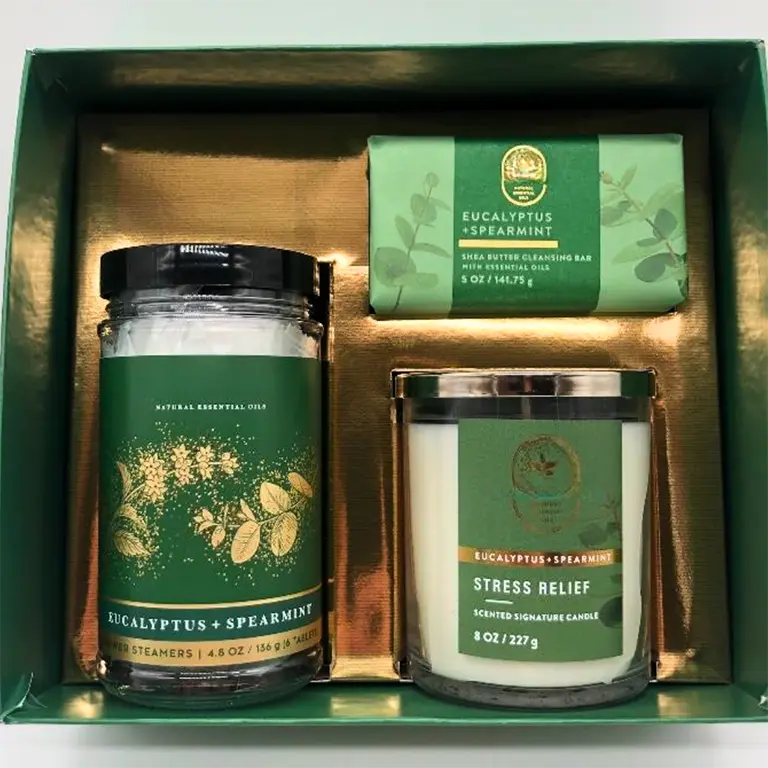
You’ve seen it on store shelves a thousand times: a skincare brand bundles a cleanser, toner, and moisturizer into one gift-ready box. A snack company packages three flavors together for a club store exclusive. A healthcare brand creates a “starter kit” with everything a new customer needs.
That’s product kitting—and if you’re a brand that sells bundled products, multi-piece sets, or promotional packages, understanding how kitting works (and when to outsource it) can save you serious time, money, and headaches.
Here’s everything you need to know.
So, What Is Product Kitting?
Product kitting is the process of assembling multiple individual items into a single, retail-ready or ship-ready package. Think of it as taking everything that belongs together, like the products, the packaging, the inserts, and all those finishing touches, and turning it into one cohesive, polished unit that’s ready to sell.
That might look like a holiday gift set with three beauty products nestled in a rigid box, a club store variety pack with multiple snack flavors bundled into a tray display, or a healthcare starter kit with a device, accessories, and instructions all tucked inside a retail-ready carton.
The format varies by brand and channel, but the throughline is always the same: individual components need to come together, be assembled with precision, and meet a specific standard before they’re ready to hit shelves or doorsteps.
Simple in concept. A lot more involved in execution–especially at scale.
How Does the Kitting Process Work?
Whether kitting is done in-house or by a partner, like Accel, who does contract kitting services, the core process typically follows these steps:
- Component Sourcing & Receiving: All items that make up the kit—finished products, packaging materials, inserts, labels, ribbons, tissue paper, etc.—are received and inventoried. Before assembly begins, every component is inspected for quality.
- Work Order & Assembly Instructions: A detailed work order is created that specifies exactly how the kit should be assembled: what goes in, in what order, how it should be oriented, and what the finished product should look like. This is the blueprint every assembler follows.
- Assembly: This is where the kitting actually happens. Teams work alongside semi-automated equipment on high-speed production lines, assembling each kit to spec with the kind of consistency that manual-only operations struggle to maintain. For high-volume or retail programs, this matters: every unit has to look identical, and the infrastructure behind the process is what makes that repeatable at scale.
- Quality Control: Assembly runs smoothly until it doesn’t, which is why quality checks happen throughout the process rather than at the end. Visual inspections, weight checks, and photo documentation catch issues before they spread across a run. The standard worth holding any copacker to is documented checks on a consistent cadence, with records your team can actually access and review. That level of transparency is what separates a reliable production partner from one that hands you a finished pallet and hopes for the best.
- Labeling & Final Packaging: Once assembled and approved, kits are labeled, sealed, and packed into shipping cartons to client specs. Cartons are then palletized, wrapped, and labeled to exactly match retailer or distributor requirements. For retail programs, this means correct barcodes, proper pallet configurations, and compliant labeling at every level of the pack. Full pallet output, done to spec, ready to move.
- Fulfillment: Finished kits are staged and shipped to wherever they need to go—a distribution center, a retailer, a 3PL, or directly to consumers.
Why Do Brands Use Product Kitting Services?
A lot of brands start kitting in-house, and at first, it makes sense. Low volumes, simple configurations, and easy enough to manage. But as programs grow, kitting consumes more space, labor, and bandwidth than anyone planned for. That’s usually when brands start looking for a better option.
The case for contract kitting services comes down to a few things.
First, infrastructure: kitting requires serious square footage to receive components, run assembly lines, store finished goods, and ship. Second, demand fluctuates, and kitting operations need to flex with it. Contract kitting services absorb that variability through a mix of automation and scalable labor, so you’re not over-hiring ahead of peak season or scrambling when a large program lands unexpectedly. The right partner scales up without the chaos.
Beyond capacity, there’s the expertise factor. Not every kit is as straightforward as it looks—tight tolerances, retailer compliance requirements, and unusual packaging formats have a way of surfacing once you’re in production. Experienced kitting teams bring engineering problem-solving to the table from the start, saving time, reducing cost, and protecting quality.
And speaking of quality: for retail programs, it’s non-negotiable. Major retailers penalize non-conforming shipments, and consumers don’t give second chances to a bundle that arrived looking rough. Strong QC programs—dedicated quality reps, photo documentation, defect tracking—give accountability that’s hard to replicate internally.
The result? Product kitting services mean faster time to market, fewer surprises, and a program that runs the way it’s supposed to.
What Contract Kitting Services Look Like at Accel
At Accel, product kitting isn’t a side offering; it is core to who we are. We’ve spent 30 years assembling gift sets, promotional bundles, retail kits, and club programs for brands across beauty, personal care, food, CPG, and healthcare. We’re operating out of 517,000 sq. ft. with 60+ flexible lines, so scaling up doesn’t require any capital investment on your end.
In practice, that looks like:
- Premium beauty & personal care gift sets assembled with rigid box manufacturing, custom trays, and finishing details that have to be perfect
- Club store packaging is built to precise configurations with full retailer compliance
- Multi-component promotional bundles across cosmetics and personal care with branded packaging and insert cards
Our engineering team doesn’t just assemble what you hand us–we look at your program and ask how we can make it better: faster to produce, less expensive to run, more consistent at scale. And should anything unexpected come up mid-project, we handle it. Whether that’s a component arriving off-spec or a situation that calls for quick-thinking rework, we treat your problem like it’s our problem, because as your partner, it is.
Ready to Simplify Your Kitting Operations?
If managing kitting in-house is stretching your team thin, or you’re gearing up for a program that needs to run flawlessly, you don’t have to figure it out alone. The right contract kitting services partner brings the capacity, expertise, and accountability to get it done right, on time, every time.
Let’s talk about what your program needs. Contact Accel Inc. to explore kitting solutions tailored to your products, your timeline, and your retail requirements.